
You check your bank statement and see a series of deductions: SMS charges, card maintenance fees, transfer levies, account maintenance. By the end of the year, you have paid thousands of naira in charges—money that could have gone into savings or investments.
This is the reality for millions of Nigerians. Traditional banks charge fees for almost everything. But here is the good news: you can build a zero-fee banking stack in Nigeria that eliminates these charges entirely, while still enjoying the security and features of a traditional bank.
The strategy is simple: use digital banks like Kuda and OPay for your daily transactions, and keep a traditional bank account only for things that absolutely require it (salary, international transfers, large business transactions). This hybrid approach is how smart Nigerians are saving ₦30,000 to ₦100,000 every year in banking fees.
In this guide, you will learn exactly how to build a zero-fee banking stack in Nigeria step by step. You will discover the fees Kuda and OPay charge, which traditional banks to keep, and how to route your money to avoid every avoidable charge.
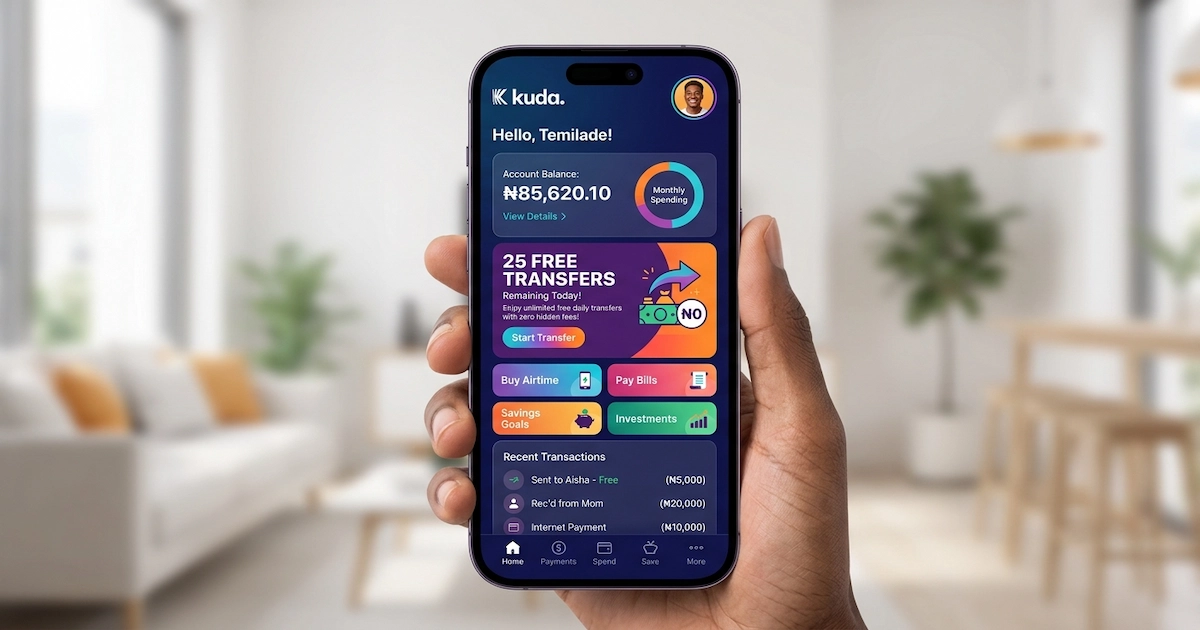
Fact: Over 7 million Nigerians bank with Kuda because of its zero-fee model, including 25 free transfers monthly and no maintenance fees.
Why You Are Paying Too Much in Bank Charges
Before building your zero-fee banking stack in Nigeria, understand where your money is leaking.
Common Bank Charges Nigerians Pay
| Charge Type | Typical Amount | Frequency |
|---|---|---|
| Monthly maintenance fee | ₦50–₦100 | Monthly |
| SMS alert charges | ₦4–₦10 per alert | Per transaction |
| Transfer fees (traditional banks) | ₦50–₦100 per transfer | Per transaction |
| Stamp duty on transfers ≥₦10,000 | ₦50 | Per qualifying transfer |
| Card maintenance fee | ₦50–₦100 | Monthly |
| ATM withdrawal (other banks) | ₦100 per ₦20,000 | Per withdrawal |
A 2026 analysis found that traditional banks like GTBank, Zenith, and Access charge significantly more for transfers compared to fintechs. For example, OPay charges ₦10 flat for interbank transfers, while GTBank charges ₦100.
What the CBN Has Changed in 2026
The Central Bank of Nigeria (CBN) issued a revised Guide to Charges effective May 1, 2026. Key changes include:
- Card maintenance fees scrapped on naira-denominated debit and credit cards
- Virtual cards remain free of maintenance charges
- Card issuance/replacement fee increased from ₦1,000 to ₦1,500
- Electronic transfers ≤₦5,000 remain free
- Transfers ₦5,000–₦50,000 attract ₦10 fee
- Transfers above ₦50,000 attract ₦50 fee
This is good news. But to truly build a zero-fee banking stack in Nigeria, you need to go further by choosing the right accounts for the right purposes.
The Anatomy of a Zero-Fee Banking Stack
A zero-fee banking stack in Nigeria is not about finding one bank that charges nothing. It is about allocating your money across multiple accounts so that no single charge hits you unnecessarily.
The Three-Layer Stack
| Layer | Purpose | Recommended Account |
|---|---|---|
| Layer 1: Daily Spending | Transfers, bills, airtime, data, POS | Kuda or OPay |
| Layer 2: Savings | High-yield savings, emergency fund | Kuda Savings or PiggyVest |
| Layer 3: Traditional Anchor | Salary, international transfers, large transactions | GTBank, Zenith, or Access |
By routing your money through the right layers, you avoid the fees that traditional banks charge for daily transactions while still keeping the features you cannot get from fintechs.
Layer 1: Kuda vs OPay for Daily Spending
For your daily spending account, you need a platform that offers free or near-free transfers, no maintenance fees, and reliable uptime. Kuda and OPay are the two leading options.
Kuda Bank: Best for Free Transfers
Kuda, often called “The Bank of the Free,” offers:
- 25 free interbank transfers per month
- ₦10 fee after free transfers for transfers below ₦1 million
- No monthly maintenance fees
- No minimum balance requirement
- 15% p.a. savings rate
- Visa debit card
- “Spend & Save” auto-budgeting feature
Kuda is licensed as a Microfinance Bank (MFB) by the CBN.
Best for: Salaried workers and individuals who make regular transfers but want to avoid per-transaction fees.
OPay: Best for Cash Access and High Volume
OPay offers:
- Free OPay-to-OPay transfers
- ₦10 flat interbank transfer fee (starting from ₦5)
- No monthly maintenance fees
- Over 300,000 agent locations nationwide for cash deposits and withdrawals
- 15% p.a. savings rate
- Loans up to ₦500,000 with interest rates as low as 0.3% daily
- Verve debit card
OPay is licensed as a Payment Service Bank (PSB) by the CBN.
Best for: Users who frequently deal with cash, small business owners, and anyone who needs to send money to agents for deposit.
OPay’s ₦9,999 Quick Transfer Button
In January 2026, OPay added a ₦9,999 quick-select button to its transfer screen. This allows users to avoid the ₦50 stamp duty that applies to transfers of ₦10,000 and above. The feature exploits the exemption for transfers below ₦10,000. If you need to send ₦20,000, you can split it into two transfers of ₦9,999 and ₦10,001—though the second will still attract stamp duty.
Practical tip: For transfers just above ₦10,000, consider splitting into two transfers below the threshold to avoid the ₦50 stamp duty. But do not abuse this—it is a workaround, not a loophole to exploit for large sums.
Kuda vs OPay: Head-to-Head
Which Should You Use?
Choose Kuda if: You make many interbank transfers and want to maximize free transfers. Kuda’s 25 free monthly transfers are ideal for salaried workers paying bills and sending money to family.
Choose OPay if: You deal with cash frequently, need agent access, or send small amounts often. OPay’s ₦10 flat fee and agent network make it unbeatable for cash-heavy users.
Pro move: Use both. Keep OPay for cash deposits and withdrawals via agents, and Kuda for your monthly bill payments and transfers.
Also read Best Investment Apps in Nigeria: 9 Platforms to Grow Your Money
Layer 2: Savings That Earn While You Sleep
A zero-fee banking stack in Nigeria is not just about avoiding charges. It is also about earning interest on your money.
Kuda Savings
Kuda offers a 15% p.a. savings rate on its savings account. The “Spend & Save” feature automatically saves a percentage of your spending, making it effortless to build an emergency fund.
OPay Savings
OPay also offers 15% p.a. on savings. The interest is calculated daily and paid monthly.
PiggyVest and Alternatives
For dedicated savings, consider PiggyVest, which offers fixed savings with 12–16% returns. You can automate transfers from your Kuda or OPay account to PiggyVest weekly or monthly.
Strategy: Keep your daily spending account (Kuda or OPay) with a small balance. Move the rest to a high-yield savings account or PiggyVest. This reduces the temptation to spend and ensures your money is working for you.
Layer 3: When You Still Need a Traditional Bank
Despite the rise of fintechs, there are situations where you cannot avoid a traditional bank.
What Traditional Banks Are Still Needed For
| Use Case | Why Fintechs Fall Short |
|---|---|
| Salary payment | Most Nigerian employers require a commercial bank account |
| International transfers (SWIFT) | Traditional banks offer domiciliary accounts and SWIFT transfers |
| Large business transactions (>₦10M) | Traditional banks have higher limits and dedicated business support |
| Letters of credit and bank guarantees | Only commercial banks issue these |
| Mortgage applications | Traditional banks have the capital for long-term lending |
| Visa applications | Embassies often require statements from commercial banks |
Which Traditional Bank to Keep
For your traditional anchor account, consider:
- GTBank: Strong digital app, reliable service
- Zenith: Excellent corporate banking, strong reputation
- Access: Largest branch network, good for business banking
- First Bank: Longest history, widely accepted
Important: Keep your traditional bank account, but do not use it for daily transfers. Fund it only when necessary, and move money out as soon as possible.
Minimizing Traditional Bank Charges
Even with a traditional bank, you can reduce fees:
- Disable SMS alerts if you have email alerts (email alerts are free; SMS alerts can be charged on a cost-recovery basis)
- Avoid interbank transfers from your traditional account—use Kuda or OPay instead
- Use your traditional bank’s ATM to avoid the ₦100 per ₦20,000 fee for other banks’ ATMs
- Negotiate account maintenance fees if you are a high-value customer (the CBN says fees are negotiable)
Also read Best Loan Apps in Nigeria (2026) Updated, Safe, and FCCPC‑Approved
Step-by-Step: Building Your Zero-Fee Banking Stack in Nigeria
Follow these steps to build your zero-fee banking stack in Nigeria today.
Step 1: Open a Kuda Account
- Download the Kuda app from Google Play or Apple Store.
- Click “Sign Up” and enter your details (name, email, phone number).
- Add your BVN for verification.
- Take a selfie for identity confirmation.
- Your account is opened within minutes.
Step 2: Open an OPay Account
- Download the OPay app.
- Register with your phone number and email.
- Complete KYC with your BVN and ID.
- Fund your account via bank transfer or agent deposit.
Step 3: Keep Your Traditional Bank Account
Do not close your GTBank, Zenith, or Access account. Keep it active for salary and large transactions. Ensure you have a debit card (even if you do not use it daily).
Step 4: Set Up Your Money Flow
Here is how money should move through your stack:
- Salary lands in your traditional bank account.
- Immediately transfer 80% to Kuda or OPay (this is free from the fintech side; you may pay a small fee from the traditional bank, but it is worth it).
- Keep 10% in your traditional account for emergencies or bills that require it.
- Move 70% to savings (Kuda savings, PiggyVest, or a high-yield account).
- Spend from Kuda or OPay for all daily transactions.
Step 5: Optimize Your Transfers
- Use Kuda’s 25 free transfers for bill payments and sending money to family.
- Use OPay for cash deposits/withdrawals via agents.
- Use OPay’s ₦9,999 button for transfers just under ₦10,000 to avoid stamp duty.
- Batch your transfers to reduce the number of transactions.
Step 6: Disable Unnecessary Charges
- Turn off SMS alerts on your traditional bank account if you have email alerts (email alerts are free).
- Do not request a new card unless necessary (card issuance now costs ₦1,500).
- Use virtual cards for online payments (virtual cards have no maintenance fees).
Real-World Example: How One Nigerian Saves ₦40,000/Year
Name: Chinedu (pseudo name)
Location: Lagos
Monthly salary: ₦150,000
Before building a zero-fee banking stack in Nigeria:
- Traditional bank transfer fees: ₦100 per transfer × 10 transfers/month = ₦1,000/month
- SMS alert charges: ₦4 per alert × 20 alerts/month = ₦80/month
- Card maintenance: ₦50/month
- ATM withdrawals (other banks): ₦100 × 4 = ₦400/month
- Total: ₦1,530/month = ₦18,360/year
After building a zero-fee banking stack in Nigeria:
- Kuda free transfers: ₦0 (within 25 free)
- OPay transfers: ₦10 × 5 = ₦50/month, ₦600/year
- Savings interest earned: ₦500/month, ₦6000/year
Annual savings: (₦18,360–₦600) + ₦6,000 in interest = ₦23,760
And this does not include the mental relief of not worrying about hidden charges.
Common Mistakes to Avoid
| Mistake | Why It Hurts | Solution |
|---|---|---|
| Using only a traditional bank | You pay ₦50–₦100 per transfer unnecessarily | Open Kuda or OPay for daily transactions |
| Keeping all money in a fintech | Fintechs are not ideal for large transactions or international transfers | Keep a traditional bank for salary and large transactions |
| Ignoring stamp duty | ₦50 per transfer adds up | Use OPay’s ₦9,999 button for small transfers |
| Not disabling SMS alerts | SMS alerts cost money; email alerts are free | Switch to email alerts |
| Requesting new cards unnecessarily | Card issuance now costs ₦1,500 | Use virtual cards for online payments |
Frequently Asked Questions (FAQ)
What is a zero-fee banking stack in Nigeria?
A zero-fee banking stack in Nigeria is a strategy where you use digital banks (Kuda, OPay) for daily transactions to avoid fees, while keeping a traditional bank account only for salary, international transfers, and large business transactions.
Does Kuda really offer 25 free transfers per month?
Yes. Kuda offers 25 free interbank transfers every month. After that, transfers below ₦1 million cost ₦10 each.
Is OPay free for transfers?
OPay offers free OPay-to-OPay transfers. For interbank transfers, the fee starts at ₦5.
What is the ₦9,999 quick transfer button on OPay?
OPay added a ₦9,999 quick-select button to help users avoid the ₦50 stamp duty on transfers of ₦10,000 and above. Transfers below ₦10,000 are exempt from stamp duty.
Are card maintenance fees really scrapped?
Yes. The CBN scrapped card maintenance fees on naira-denominated debit and credit cards effective May 1, 2026. Virtual cards also remain free of maintenance charges.
Do I still need a traditional bank?
Yes, for salary payments, international transfers (SWIFT), large business transactions, letters of credit, mortgages, and visa applications. A traditional bank is your “anchor” account.
How much can I save with a zero-fee banking stack?
Depending on your transaction volume, you can save ₦20,000 to ₦100,000 per year in banking fees. The exact amount depends on how many transfers, ATM withdrawals, and SMS alerts you currently pay for.
Conclusion
You now know exactly how to build a zero-fee banking stack in Nigeria. The strategy is simple: use Kuda and OPay for daily spending, keep your traditional bank for salary and large transactions, and route your money to avoid every avoidable charge.
The CBN’s 2026 revised fee guide has made this easier than ever by scrapping card maintenance fees and keeping small transfers free. But the real savings come from choosing the right account for the right purpose.
Your action plan:
- Download Kuda and OPay apps.
- Complete your KYC.
- Set up your money flow: salary → traditional bank → Kuda/OPay → savings.
- Disable SMS alerts on your traditional account.
- Start using OPay’s ₦9,999 button for small transfers.
Stop paying for banking. Start keeping your money.