
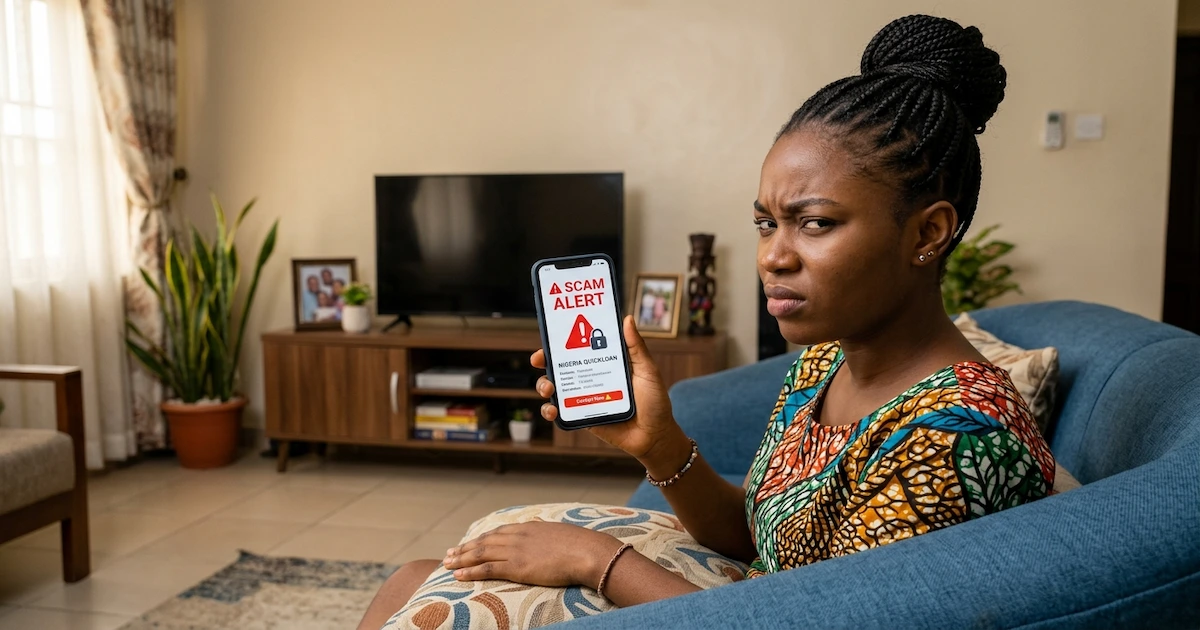
You see an Instagram ad: “Get ₦500,000 loan in 5 minutes. No collateral. No guarantor. Instant approval.” You download the app, grant permissions, and receive the money. Two weeks later, your contacts are receiving messages calling you a fraudster. Your loan balance has tripled. You cannot delete the app because it has access to your photos and messages.
This is the reality for thousands of Nigerians. Loan scams are not just about losing money. They are about losing your reputation, your privacy, and your peace of mind.
In this guide, you will learn exactly how to spot a loan scam in Nigeria. You will discover the red flags that separate legitimate lenders from predatory operators, the regulatory framework that protects you, and the steps to take if you become a victim.
Fact: The FCCPC has placed over 100 unregistered loan apps on its enforcement watchlist, with 54 apps deleted from Google Play Store for violating regulator rules .
The Nigerian Loan App Problem: Why This Matters
Nigeria’s digital lending sector has grown explosively since 2020. It offers millions of Nigerians quick access to credit through mobile applications. But this growth has also brought widespread consumer complaints: exploitative interest rates, hidden fees, opaque loan agreements, and aggressive debt recovery methods .
The complaints are not isolated. Across social media and consumer forums, borrowers have repeatedly alleged:
- Excessive interest charges that multiply loan balances
- Hidden fees not disclosed upfront
- Aggressive recovery methods involving harassment
- Defamatory messages sent to family members and employers
- Unauthorized access to personal data including contacts and photos
A recent viral story involved a borrower who borrowed ₦1.2 million through a lending service. After deleting and reinstalling the app, the outstanding amount had climbed to ₦9.6 million between 2024 and 2026 .
The greatest danger lies not only in the cost of borrowing but also in the methods employed by rogue operators to recover debts. Debt recovery should be governed by law, not by intimidation .
What Makes a Loan App a “Scam”?
Before diving into the red flags, understand what separates a legitimate loan app from a scam. The difference is not always obvious.
Legitimate Loan Apps:
- Are registered with the FCCPC
- Disclose all fees and interest rates upfront
- Use ethical debt recovery methods
- Protect your data and privacy
- Have physical offices and customer support
Scam Loan Apps:
- Operate without FCCPC approval
- Hide fees and charges until after you borrow
- Harass you and your contacts
- Harvest your personal data for blackmail
- Disappear when you try to complain
According to the Nigerian Communications Commission (NCC), loan shark apps impersonate reputable loan providers and promote themselves through SMS messages and social media to lure victims in need of financial assistance .
10 Red Flags: How to Spot a Loan Scam
Here are the ten most common warning signs that you are dealing with a loan scam.
1. The App Is Not on the FCCPC Approved List
This is the single most important check. The FCCPC maintains a public register of approved digital money lenders. If a loan app is not on this list, do not use it .
How to verify:
- Visit the FCCPC website and search for the lender’s name
- Cross-check with KudiCompass or similar tracking platforms
- If the app is not listed, it is operating illegally
As of 2026, over 500 digital lenders have full approval, but more than 100 unregistered loan apps remain on the commission’s watchlist .
2. The App Asks for Excessive Permissions
Legitimate loan apps need basic information: your name, BVN, and bank account. Scam apps ask for everything .
Red flag permissions:
- Access to your contact list
- Access to your photos and media
- Access to your SMS messages
- Access to your call logs
- Access to your calendar
- Access to your location
If a loan app asks for your contacts or SMS access, close it immediately. There is no legitimate reason for a lender to need your contact list .
3. The App Is Distributed via APK, Not Google Play
Scammers often distribute loan apps through dedicated scam websites and third-party app stores, sometimes even on Google Play .
Red flags:
- You are asked to download an APK file directly
- The app is not available on Google Play or Apple App Store
- You received a download link via SMS or WhatsApp
The FCCPC has partnered with Google Play and Apple App Store to remove non-compliant apps. If an app is not on these official stores, it is likely a scam .
4. The Loan Terms Are Unclear or Hidden
Legitimate lenders disclose all fees, interest rates, and repayment terms before you accept the loan. Scam apps hide the true cost until after you borrow .
Red flags:
- No clear interest rate disclosed
- Fees mentioned only in the fine print
- Repayment amount significantly higher than expected
- No loan agreement provided before disbursement
The FCCPC requires digital lenders to adopt transparent lending practices. If you cannot find the full terms, do not proceed .
5. The App Threatens Your Contacts
This is the most damaging scam tactic. Scam apps harvest your contact list and send defamatory messages to your family, friends, and employers if you are late on repayment .
Red flags:
- The app asks for your contacts “for verification”
- You receive messages from the app threatening to contact your family
- Your contacts receive messages calling you a fraudster
The NDPC is actively investigating loan operators over these violations. Unauthorized access to people’s contacts is an offense .
6. The Interest Rate Is Predatory
Legitimate lenders charge reasonable interest rates. Scam apps charge rates designed to trap you in debt.
Red flags:
- Interest rate not disclosed upfront
- Loan balance grows rapidly
- Daily interest rates of 1% or more
- Total repayment is more than double the principal
If you borrow ₦100,000 and suddenly owe ₦300,000, you are dealing with a predatory lender.
7. The App Cannot Be Deleted
Scam apps often make themselves difficult or impossible to uninstall. They may also reinstall themselves .
Red flags:
- The app resists deletion
- The app reappears after uninstalling
- You cannot find the app in your settings
- The app runs in the background without your knowledge
8. The Customer Support Is Unreachable
Legitimate lenders have customer support. Scam apps disappear when you try to contact them.
Red flags:
- No phone number listed
- No physical address
- Emails bounce back
- Social media accounts are unverified and have few followers
Fake loan pages posing as GTBank and LAPO have been identified by Africa Check. These pages were created recently, have few followers, and are not verified .
9. The App Impersonates a Reputable Bank
Scammers create Facebook pages and websites that impersonate established banks like GTBank, LAPO, and others. They use the bank’s name and logo to appear legitimate .
Red flags:
- The page is unverified
- The page was created recently
- The bank’s official page has millions of followers; the fake page has hundreds
- The page asks you to send a direct message to “apply”
- The page asks for your email password or banking details
GTBank has warned that it never asks customers to apply for loans from anywhere except its official website or banking platforms .
10. The App Asks for Your BVN or NIN Without Explanation
Legitimate lenders need your BVN for identity verification. But they should explain why they need it and how it will be used.
Red flags:
- The app asks for your BVN before showing loan terms
- The app asks for your NIN along with photos of your ID
- The app asks for your bank account password or email password
The NCC warns that loan shark apps collect extensive personal information including BVN, NIN, photos of ID cards, and selfies. This data can be used for blackmail, identity theft, or sold to other criminals .
Also read Best Loan Apps in Nigeria (2026) Updated, Safe, and FCCPC‑Approved
The Regulatory Framework: What Protects You
Understanding the regulatory landscape helps you know your rights and how to spot a loan scam.
The DEON Regulations 2025
The FCCPC introduced the Digital, Electronic, Online or Non-Traditional Consumer Lending Regulations 2025 (DEON Regulations) on July 21, 2025. These regulations require digital lenders to :
- Register with the FCCPC
- Meet consumer protection standards
- Adopt transparent lending practices
- Protect borrowers’ data
- Refrain from abusive debt recovery methods
The compliance deadline was January 5, 2026. After this date, the FCCPC began removing non-compliant apps from its approved register and from app stores .
FCCPC Enforcement Actions
The FCCPC has taken significant enforcement actions against scam loan apps :
- September 2023: 37 loan apps delisted from Google Play Store
- January 2026: 45 additional apps blacklisted
- Ongoing: 103 operators placed on a regulatory watchlist
Sanctions for non-compliance include fines of up to ₦100 million or 1% of annual turnover, operational suspensions, and director disqualifications .
NDPC Investigations
The Nigeria Data Protection Commission (NDPC) is investigating loan operators over privacy violations. The National Commissioner, Vincent Olatunji, stated that violations include accessing borrowers’ phone contact lists, sharing images without consent, and sending defamatory or threatening messages .
“Any unauthorised access to people’s contacts is an offence and we will come after them,” Olatunji warned .
How to Protect Yourself: A Practical Checklist
Before downloading any loan app, run through this checklist to spot a loan scam.
| Check | Action | Red Flag |
|---|---|---|
| FCCPC Registration | Search the FCCPC approved list | Not listed |
| App Store | Check Google Play or Apple App Store | APK download required |
| Permissions | Review what the app requests | Contacts, SMS, photos |
| Terms | Read the loan agreement | No clear interest rate |
| Customer Support | Look for phone and address | No contact information |
| Social Media | Check the page’s verification and followers | Unverified, few followers, recently created |
| Bank Impersonation | Verify through the bank’s official channels | Asks for email password |
What to Do If You Are a Victim
If you have already been targeted by a loan scam, take these steps immediately:
1. Stop Paying
Do not continue paying a predatory lender. Document everything: screenshots, messages, and transaction records.
2. Report to the FCCPC
File a complaint with the Federal Competition and Consumer Protection Commission. The FCCPC’s published register serves as a consumer information tool, and they take enforcement actions against violators .
3. Report to the NDPC
If your data privacy has been violated (contacts accessed, defamatory messages sent), report to the Nigeria Data Protection Commission .
4. Report to the NCC
The Nigerian Communications Commission has a CSIRT (Computer Security Incident Response Team) that handles reports of malicious loan apps .
5. Warn Your Contacts
If the app has accessed your contact list, warn your family and friends that they may receive defamatory messages. Tell them to ignore any messages from unknown numbers claiming you are a fraudster.
6. Consider Legal Action
Defamation and data privacy violations are legal offenses. Consult a lawyer if you have suffered reputational damage.
Frequently Asked Questions (FAQ)
How do I check if a loan app is approved in Nigeria?
Visit the FCCPC website and search their approved digital money lenders register. You can also use platforms like KudiCompass that track FCCPC loan app status .
Can a loan app access my contacts legally?
No. Unauthorized access to your contact list is a violation of your data privacy rights. The NDPC is actively investigating and prosecuting lenders who engage in this practice .
What should I do if a loan app is harassing me?
Stop all communication, document the harassment, and report to the FCCPC, NDPC, and NCC. Do not delete the evidence .
Are all loan apps on Google Play safe?
No. While Google Play has removed many non-compliant apps, some scam apps still appear. Always verify FCCPC registration before downloading .
What is the penalty for operating an illegal loan app in Nigeria?
Fines can reach ₦100 million or 1% of annual turnover. Directors can be disqualified for up to five years. Apps can be delisted and operations suspended .
How can I spot a fake loan page on Facebook?
Fake pages are usually unverified, have few followers, were created recently, and ask you to send a direct message to apply. Legitimate banks have verified pages with millions of followers .
Final Words
You now know how to spot a loan scam in Nigeria. The red flags are clear: no FCCPC registration, excessive permissions, hidden fees, contact harvesting, and unverified social media pages.
The Nigerian regulatory landscape is improving. The FCCPC has resumed enforcement of the DEON Regulations after a court affirmed its powers . The NDPC is actively investigating privacy violators . But enforcement takes time, and scammers are always finding new ways to evade detection.
Your best protection is knowledge. Verify every lender against the FCCPC approved list. Read the permissions. Read the terms. Trust your instincts. If something feels wrong, it probably is.
Before downloading any app
- Check the FCCPC register.
- Review the permissions the app requests.
- If it asks for contacts or SMS, delete it immediately.
- Report suspicious apps to the FCCPC, NDPC, and NCC.
- Share this guide with friends and family.
Do not let a loan scam destroy your finances or your reputation.